
What happens when users face a blank screen?
A few months ago, while sitting at my desk reviewing interface heatmaps for our latest user milestone, we noticed a glaring pattern in the data. People would open the app, stare at the blank text input field for several seconds, and frequently close the application without typing a single word. From a UX perspective who has spent years developing parent-focused interfaces and high-retention mobile tools, this behavior was incredibly familiar. Cognitive friction—the mental effort required to figure out what to do next—was driving them away.
When analyzing this interaction data, one thing became clear: staring at a blinking cursor is a major barrier to entry. Kai AI - Chatbot & Assistant is an AI-powered categorized assistant app for iOS and Android that provides pre-configured expert personas—like chefs, fitness coaches, and language tutors—so students, freelancers, and small teams can get immediate answers without writing complex instructions. Instead of forcing you to engineer the perfect context, the application handles the behavioral framing behind the scenes.
When users are holding a coffee in one hand and their phone in the other, typing fast and making typos like chatgps, chap gpt, or chatjpd, they do not have the patience to teach an application how to act. They simply want a fast, accurate answer.
How do open-ended text boxes compare to categorized experts?
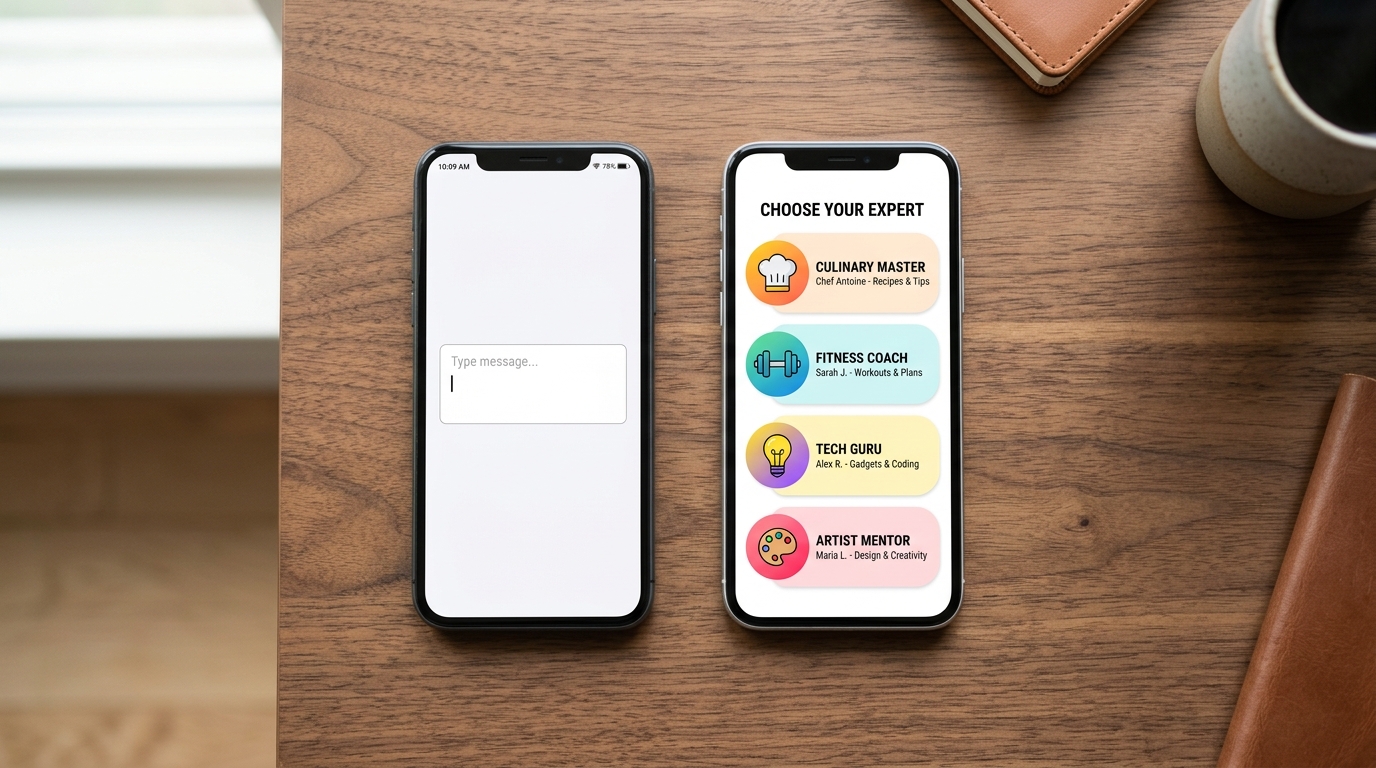
To understand the shift in mobile retention, we have to evaluate the two primary methods of interacting with digital assistants today. Side by side, the differences in user experience are significant.
Approach A: The Generic Chat Interface
This is the standard, blank-box model most people associate with modern language tools. You are presented with a blinking cursor and expected to define the rules of the interaction yourself.
- Pros: Offers infinite flexibility. If you know exactly how to write system-level instructions, you can bend the output to do almost anything.
- Cons: High cognitive load. It demands significant mental energy to format questions correctly. If you search for something like
gchat gbtorchatcgpin a hurry, spending three minutes typing a background context paragraph feels entirely counterproductive. The error rate for casual users is high, leading to frustrating, generic outputs.
Approach B: Categorized Pre-Trained Personas
This is the method utilized by Kai AI. Instead of a blank screen, you select a specific role—such as a writing assistant or a dietary planner—before you start typing. The background parameters are already set.
- Pros: Instant context. You simply type "I have chicken and broccoli, what can I make?" into the Chef persona, and it understands you want a recipe, not a nutritional essay. There is zero prompt anxiety, making it ideal for fast, daily tasks.
- Cons: Less ideal for highly abstract, unstructured brainstorming that spans multiple unrelated disciplines at exactly the same time. You are working within a defined expertise area.
Why does interaction speed dictate mobile retention?
Speed in mobile design is rarely just about how fast a server responds; it is largely about how fast a human brain can process the screen. Recent industry data heavily supports this observation. According to Lavinya Media's analysis of mobile trends, 70% of users will delete an application on their very first use if they perceive it as slow or difficult to manage. In the context of digital helpers, "slow" means requiring the user to think too hard before they can begin.
Furthermore, the Adjust "Mobile App Trends 2025" report evaluated billions of data points across various sectors. Their findings show that artificial intelligence is transitioning rapidly from a novel strategic feature to foundational app infrastructure. Specialized financial apps saw an 8% increase in session lengths because they provided focused, targeted utility. Users are rewarding specialization.
UXMode's 2025 design guide also highlights a major shift toward "minimal and silent" design languages. A silent design doesn't mean lacking features; it means the application does the heavy lifting quietly in the background. As Ayşe Çelik previously noted in her analysis of why blank AI screens are losing mobile users, when an app requires you to constantly guide its behavior, it violates this principle of silent design.
Who actually benefits from a pre-configured workflow?
Not every digital tool is built for every person, and understanding your own use case is critical to avoiding subscription fatigue. Categorized assistants like Kai AI are engineered specifically for people who value speed over granular control.
The Ideal User Profile:
- Students: Needing quick explanations for complex topics without writing out "Please act as a high school physics teacher and explain..." every single time.
- Freelancers: Jumping between drafting client emails, brainstorming marketing copy, and organizing daily schedules.
- Small Teams: Seeking reliable, categorized outputs to help manage tasks on mobile devices during commutes or off-site meetings.
Who is this NOT for?
If you are a developer looking to manually test API temperatures, adjust token limits, or write five-paragraph system-level architectures for a highly specific coding environment, a categorized mobile assistant is not your target tool. You require a raw, developer-focused sandbox, not an everyday mobile companion.
Why do quick searches highlight this usability gap?
When tracking how people find utility apps, you often see search logs filled with hurried, fragmented typing. Terms like chadgbt, chat gptt, cha t gpt, and ochat gpt are incredibly common. We even see variations like chatgtp, chapgpt, chartgpt, and chadgpt appearing in daily queries.
These typos are not accidents; they are behavioral indicators. People searching for gchat gtp or cht gpt are moving quickly. They are likely on a train, walking to a meeting, or managing kids at home. They do not have a desktop keyboard or the luxury of time. If a user typing char gbt or chat gtpt is forced into a blank screen that requires meticulous text formatting, they will abandon the session.
Elif Şahin covered this behavioral shift effectively in her step-by-step guide on the 'chag gbt' search trend, detailing how factual accuracy and user frustration collide in generic interfaces.

How should you choose your daily digital helper?
Selecting the right application for your smartphone requires looking past the marketing claims and evaluating how the tool actually functions in a high-stress, low-time environment. Consider these selection criteria before committing to a platform:
First, evaluate the ease of initiation. Does the tool require you to type a setup command before it becomes useful? If you want immediate translations, Kai AI's language tutor feature is designed for that exact outcome, bypassing the setup phase entirely.
Second, look at context retention. Categorized personas retain the context of their specific field. A fitness coach persona naturally assumes your questions are about health, diet, or exercise, reducing the chances of irrelevant responses.
Finally, consider the ecosystem reliability. Whether you are using a dedicated assistant or exploring family-oriented utilities from developers like ParentalPro Apps, the focus should always be on reducing your daily mental load, not adding to it.
Hitting 100,000 active sessions taught us that the future of mobile utility is not about giving users a blank canvas. It is about providing them with a competent expert, ready to work, the second the application opens.